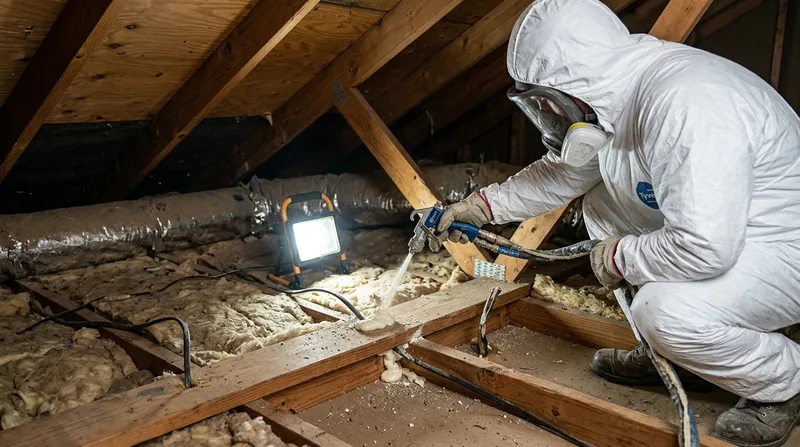




Air sealing in Charlotte stops the humid Piedmont air that leaks through top plates, rim joists, and penetrations from driving into your home year-round. These gaps let stack effect drafts pull outside air into attics and crawl spaces, undermine the R-value of insulation you already have, and push your cooling and heating bills higher than they need to be. Charlotte's hot summers and the red clay terrain beneath our older neighborhoods create persistent moisture pressure: humid air wants in through every crack. We seal these leaks with foam to stop the drafts, stabilize indoor humidity, and make your insulation system work as intended. If you're planning an attic spray foam insulation project or upgrading a crawl space, air sealing is the foundation.
Why Air Sealing Matters in Charlotte's Hot, Humid Climate
Charlotte sits in IECC climate zone 3A, where hot summers pull humid outside air through every unsealed gap and cold snaps stress rim joists and band joists. Our brick bungalows in Dilworth, Myers Park, and Plaza Midwood sit over vented crawl spaces dug into red clay that stays damp most of the year. Postwar ranches across Mecklenburg County and the newer subdivisions pushing toward Matthews and Huntersville carry vented attics that bake under the Piedmont sun. When air leaks through the top plate or around electrical penetrations, that humid air enters the attic or wall cavity, condenses on cooler surfaces, and creates the conditions for mold, rot, and settled insulation to fail faster. A sealed attic or crawl space with proper insulation stops this cycle and cuts your cooling load in summer and heating load in winter.
- Sealing top plates and penetrations stops humid air from entering the attic and driving up your cooling bills in summer.
- Sealed rim joists and band joists eliminate stack effect drafts that pull cold air into basement and first-floor spaces in winter.
- Air sealing makes blown-in or spray foam insulation work as designed, instead of being undermined by constant air movement.
- Stopping air leaks reduces the strain on your HVAC system and extends the life of your insulation.
Air leaks are invisible, but their cost is real. Getting them sealed before or alongside your insulation work is the professional standard.
Key info: North Carolina's building code requires air barriers in attics and crawl spaces to control moisture and drafts. The building official at your local permit office can tell you what applies at your address. Check with Mecklenburg County Building Services or your city's building department to confirm what sealing and insulation specs your home requires.
How We Seal Air Leaks in Charlotte Homes
Air sealing starts with finding where the air is leaking. We look at top plates where the framing meets the attic, electrical and plumbing penetrations, band joists, rim joists, and any gaps around HVAC ducts or vents. Once we identify the leaks, we use closed-cell or open-cell spray foam to seal the gaps, depending on the location and your insulation plan. Foam expands to fill irregular gaps that caulk or weatherstripping would miss, and it bonds to wood, metal, and concrete. The result is an air barrier that stays sealed for the life of the building.
- We inspect the attic, crawl space, rim joist, or band joist to map all air leaks and penetrations.
- We seal gaps around electrical outlets, plumbing vents, HVAC ducts, and other penetrations with foam.
- We foam the top plate perimeter to stop stack effect drafts from pulling outside air into the attic.
- We verify the sealed areas are complete and continuous before we move to the next phase of insulation.
Air sealing is often the first step before blown-in or spray foam insulation, because insulation works only if the air can't bypass it.
Example: A 1960s ranch in Mint Hill with an attic that has settled fiberglass and no rim joist foam leaks cold air into the basement in January and humid air into the attic in July. We seal the rim joist, the top plate, and the band joist with closed-cell foam, then top up the attic insulation to bring it to code. The homeowner sees lower utility bills and stops feeling drafts along the basement rim.
Air Sealing Methods and When to Use Them
| Approach | Description | Best For |
|---|---|---|
| Closed-cell foam | High-density, rigid foam with an R-value around 6.5 per inch. Stops air and moisture. Low permeability. | Rim joists, band joists, crawl spaces, and areas where moisture control matters. |
| Open-cell foam | Lower-density, semi-rigid foam with an R-value around 3.5 per inch. Stops air, allows vapor to pass. | Attic top plates, interior wall cavities, and locations where vapor permeability is desired. |
| Injection foam | Low-pressure foam injected through small holes into wall cavities or rim joists without removing drywall. | Retrofitting pre-1980 frame homes where the wall cavity is empty and the drywall stays intact. |
| Caulk and weatherstrip | Polyurethane caulk or foam backer rod for small, regular gaps. Durable but only fills straight lines. | Trim details, small gaps between framing members, and cosmetic touch-ups after foam work. |
The choice of method depends on the location, the size and shape of the gap, and whether moisture control is critical. We specify the right foam for each part of the job and explain why in your written estimate.
Air Sealing Cost in Charlotte: What to Expect
Air sealing projects in Charlotte typically start at $650 for a focused job, such as sealing a rim joist, topping up a band joist, or sealing penetrations in a small attic. Larger jobs, such as sealing the entire top plate perimeter of a two-story home or a full crawl space band joist, run higher because they require more material, more labor, and more time on site. The cost also depends on how many gaps need sealing, how easy they are to reach, and whether you're sealing during a new insulation project or as a standalone upgrade.
- Rim joist and band joist sealing in a single basement or crawl space: typically $650 to $1,200.
- Top plate sealing in a full attic (1,500 to 2,500 sq ft): typically $1,200 to $2,000.
- Injection foam in a pre-1980 exterior wall: typically $8 to $15 per linear foot, depending on wall height and cavity depth.
- Combination jobs (rim joist plus attic top plate plus HVAC duct sealing): typically $2,000 to $3,500.
The best way to know what your home will cost is to get a free written estimate that includes the square footage to be sealed, the foam type and thickness, and the R-value or permeability rating. We provide that detail in every estimate. See our pricing overview for more context, and call us at (980) 217-3281 to schedule your free estimate.
What to Look for When Hiring an Air Sealing Contractor Near Me in Charlotte
Air sealing is not glamorous work, but it is precise work. A good estimate tells you exactly what is being sealed, what foam is being used, how thick it will be, and what R-value or vapor permeability you are getting. A bad estimate has no specifications, no thickness, no R-value, and a price that seems too low. Here is what to verify when you call an air sealing contractor near Charlotte.
- Ask for a written estimate with the foam type (closed-cell or open-cell), thickness in inches, and R-value or permeability rating for each zone.
- Verify the contractor is fully insured and ask for a current certificate of insurance naming you as an additional insured.
- Check that the contractor has a local address and local phone number, and that they are reachable after the job is done.
- Ask whether they pull permits if your city or county requires one for attic or crawl space work, and get their answer in writing.
- Request references from three recent jobs in Charlotte, Pineville, Matthews, or nearby areas, and actually call them.
- Confirm the re-entry time (typically 24 to 48 hours for spray foam) and the ventilation plan during cure.
If the contractor promises immediate re-entry, has no insurance, and cannot name the foam type or thickness, walk away. Our team is ready to give you the straight story. Call us at (980) 217-3281 or request a free estimate online.
Air Sealing in Charlotte: Pricing Guide
| Service | Price | Details |
|---|---|---|
| Rim joist or band joist sealing | Starting at $650 | Single basement or crawl space area, closed-cell foam, labor and material included for typical access |
| Attic top plate sealing | Starting at $1,200 | Full perimeter of top plate, 1,500 to 2,500 sq ft attic, open-cell or closed-cell foam, complete air barrier |
| Injection foam in exterior wall cavities | $8 to $15 per linear foot | Pre-1980 frame homes, retrofit without drywall removal, based on wall height and cavity depth |
| Combination air sealing project | On estimate | Rim joist plus attic top plate plus HVAC duct sealing or crawl space band joist, priced after on-site inspection |
| Travel | Included | Charlotte, Pineville, Matthews, Mint Hill, Belmont, Harrisburg, Huntersville, and surrounding areas, no mileage fee |
| Free written estimate | No charge | Response within 24 hours at (980) 217-3281, includes foam type, thickness, R-value, and detailed scope |
Indicative pricing, the exact cost depends on square footage, finish, and site access. Free personalized estimate within 24h at (980) 217-3281.


