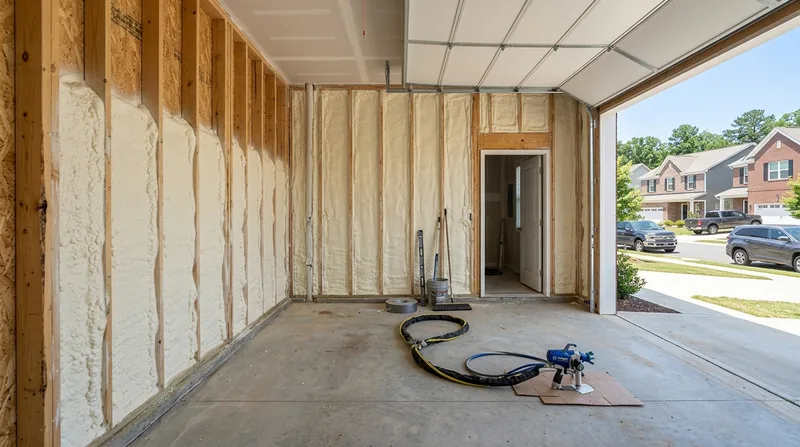




Garages across Charlotte's newer subdivisions in Huntersville, Matthews, and the outer rings of Mecklenburg County often sit uninsulated, absorbing brutal summer heat and losing conditioned air in winter. A typical two-car garage can swing 20 to 30 degrees hotter than the outdoor air on a sunny afternoon, turning a workspace or storage area into an oven. Garage spray foam insulation in Charlotte seals the walls and ceiling to stabilize temperature, protect stored goods, and cut the cost of heating or cooling an attached home. We spray foam garage cavities with closed cell or open cell foam, seal air leaks around doors and rim joists, and leave you with a finished, conditioned space that works year-round. Whether you use your garage as a workshop, hobby space, or climate-controlled storage, the right insulation strategy makes a measurable difference in comfort and utility costs.
Why Garage Insulation Matters in Charlotte's Heat and Humidity
Charlotte sits in climate zone 3A with hot, humid summers that push outdoor temperatures into the low 90s for weeks at a time. An uninsulated garage ceiling and walls allow that heat to radiate directly into the space, and if your garage is attached to your home, that thermal load bleeds into adjacent rooms, forcing your air conditioning to work harder. Winter cold snaps, though mild by northern standards, still stress an uninsulated garage structure and any rim joist or floor cavity that connects to a conditioned space. Beyond comfort, a temperature-controlled garage protects tools, electronics, paint, seasonal items, and vehicles from the extremes that degrade them over time.
- Uninsulated garage ceilings allow summer heat to penetrate the attic space above, raising cooling costs for the entire home.
- Open garage doors and poorly sealed frames leak conditioned air year-round, especially in attached garages connected to living spaces.
- Sealed foam insulation blocks humidity and temperature swings that damage stored goods, tools, and vehicle finishes.
- A finished garage with stable temperature becomes usable workshop or storage space without seasonal restrictions.
Addressing garage insulation is one of the fastest payback improvements you can make in a newer Charlotte home, and it directly reduces the load on your central air conditioning system during peak summer months.
Local example: A two-car garage in a Huntersville or Matthews subdivision with 400 square feet of ceiling and walls can reach 105 to 110 degrees on a 90-degree summer day. Spray foam insulation at R-15 to R-21 (closed cell) or R-13 to R-19 (open cell) cuts that peak by 15 to 20 degrees, protecting stored items and reducing the cooling load on the attached home.
For more on how spray foam controls temperature and moisture in different spaces, see our guide to closed cell spray foam insulation in Charlotte.
How We Insulate and Seal Your Charlotte Garage
Our process starts with a walk-through to assess the garage structure, identify air leaks around doors and rim joists, and measure ceiling and wall cavities. We clear the space, protect vehicles and stored items, and set up mechanical ventilation to manage fumes during spray. We then spray foam the ceiling first, working from one end to the other in even passes, then move to the walls and any rim joist cavities that connect to conditioned space. After the foam sets, we seal any remaining gaps with caulk or foam, and you can re-enter the space safely within 24 to 48 hours depending on foam type and thickness.
- We conduct a free on-site estimate and explain the R-value and thickness needed for your specific garage layout and use case.
- We spray foam in controlled passes with correct drum temperature and ratio, avoiding the thin, weak, or uneven coatings that plague rushed jobs.
- We run mechanical ventilation during cure to manage odor and VOC release, and we provide a clear re-entry window so you know when the space is safe.
- We seal rim joists and band joists where the garage structure meets the home's foundation or rim beam, stopping air and moisture infiltration at the source.
The result is a finished, durable insulation layer that requires no maintenance and performs for the life of the garage structure.
Real scenario: A homeowner in Mint Hill with a 400-square-foot attached garage and plans to use it as a woodworking shop calls for an estimate. We identify 180 board feet of ceiling cavity and 240 board feet of wall cavity, plus a 40-foot rim joist that bleeds air into the adjacent laundry room. We recommend 1.5 inches of closed cell foam (R-10 per inch) on the ceiling, 2 inches on the walls (R-13), and 2 inches on the rim joist, with caulk at the door frame. The job takes one day, and the garage is usable the next morning.
Learn more about our approach to air sealing in our air sealing service page.
Garage Insulation Methods
| Method | Description | Best For |
|---|---|---|
| Closed Cell Spray Foam (1.5 to 2 inches) | Dense, rigid foam with R-value of 6 to 7 per inch. Blocks air and moisture completely. Adds structural stiffness to walls and ceilings. | Garages in humid climates, attached garages where air sealing is critical, spaces with high moisture or temperature swings. |
| Open Cell Spray Foam (3 to 4 inches) | Lighter, spongy foam with R-value of 3.5 to 3.7 per inch. Allows some moisture vapor movement. Lower cost than closed cell at equivalent R-value. | Detached garages where cost is a priority, spaces where sound dampening is desired, low-moisture environments. |
| Closed Cell on Ceiling, Open Cell on Walls | Hybrid approach: closed cell on the ceiling (where moisture and heat load are highest) and open cell on walls (lower cost, adequate R-value). | Balanced budgets where attached garages need air sealing at the rim but wall insulation can be more economical. |
| Foam Plus Caulk and Gaskets | Spray foam in cavities combined with weatherstripping, caulk, and door gaskets to seal frames, thresholds, and service penetrations. | Garages where air sealing is as important as insulation value, attached garages where conditioning loss at doors is a concern. |
Garage Spray Foam Insulation Cost in Charlotte: What to Expect
Garage spray foam insulation in Charlotte typically starts at $1,200 for a single-car or small two-car garage with basic ceiling and wall coverage. The final price depends on the square footage of insulated surface, the foam type (closed cell or open cell), the desired R-value, and whether rim joists or other air leaks need sealing. A standard two-car garage with 400 to 500 square feet of ceiling and wall space usually runs between $1,800 and $2,800 depending on foam type and thickness. Larger garages, garages with complex geometry, or jobs that include significant rim joist sealing will be higher.
Several factors move the price within that range. A detached garage insulated with open cell foam costs less than an attached garage with closed cell foam because air sealing and moisture control are less critical. Access to the ceiling (whether you have a finished attic above or open trusses) affects spray patterns and crew time. If the garage has existing insulation that must be removed first, that adds labor and disposal cost. Getting written estimates from two or three contractors ensures you understand what is included at each price point and can compare R-value and thickness specifications side by side.
Visit our full pricing page for detailed breakdowns of common garage scenarios and to see how factors like foam type and coverage area affect your final quote.
What to Look for When Hiring a Spray Foam Insulation Contractor Near Me in Charlotte
Choosing the right contractor for your garage insulation is as important as choosing the insulation itself. The spray foam trade includes local, independent shops, national franchises, and out-of-state rigs that spray a job in an afternoon and disappear. The strongest signal of a competent contractor is a written estimate that specifies the R-value per inch of foam, the total thickness in inches, the board footage of coverage, and the expected cost per board foot or total price. Any estimate without those details is incomplete and should be a red flag.
- Verify that the contractor is fully insured and can provide a current certificate of insurance naming your address as additional insured.
- Ask whether permits are required for garage insulation in your city or county, and confirm that the contractor understands local building code requirements for ventilation and thermal barriers.
- Request references from recent garage or residential spray foam projects and follow up with at least one to ask about odor management, cleanup, and the contractor's responsiveness after the job.
- Check that the contractor uses mechanical ventilation during spray and cure, and that they provide a clear re-entry window rather than promising immediate occupancy.
- Ask about the manufacturer warranty on the foam itself and the contractor's workmanship warranty on the installation, and get both in writing.
A local contractor with a verifiable track record, clear communication about what is included at each price point, and transparent answers about permits and safety is worth the effort to find and will deliver a better result than a cut-rate estimate with no specifications.
Ready to get started? Contact us for a free estimate at (980) 217-3281. We respond within 24 hours and will walk you through the options for your specific garage.
Garage Spray Foam Insulation in Charlotte: Pricing Guide
| Service | Price | Details |
|---|---|---|
| Single-car or small garage (up to 250 sq ft) | Starting at $1,200 | Ceiling and walls with open cell or closed cell foam, includes basic rim joist sealing and caulk at doors |
| Standard two-car garage (300-500 sq ft) | Starting at $1,800 | Closed cell or open cell ceiling and wall coverage, full rim joist sealing, weatherstripping at overhead door, based on foam type and thickness |
| Attached garage with high air sealing demand | Starting at $2,200 | Closed cell foam on ceiling and rim, open cell on walls, full caulking of frame penetrations, door gaskets, and blower door verification |
| Garage with existing insulation removal | On estimate | Removal and disposal of old fiberglass or cellulose, cleanup, and new foam installation requires site measurement to establish labor and disposal cost |
| Travel and site visit | Included | No mileage charge or travel fee within Charlotte and surrounding Mecklenburg County service areas |
| Free written estimate | No charge | Includes R-value, thickness, board footage, and itemized pricing; response within 24 hours at (980) 217-3281 |
Indicative pricing, the exact cost depends on square footage, finish, and site access. Free personalized estimate within 24h at (980) 217-3281.


