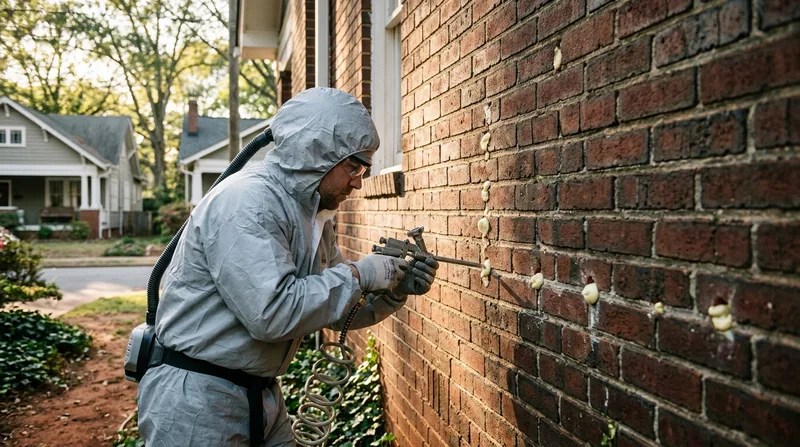




Older brick and frame homes throughout Charlotte, particularly in Dilworth, Plaza Midwood, and Myers Park, were built with hollow wall cavities that offer no insulation whatsoever. These walls pull hot summer air and cold winter drafts straight through the envelope, driving up heating and cooling costs year-round. Wall and injection foam insulation fills those cavities from the outside without tearing into the home, using small drilled holes and low-pressure injection to seal the void completely. This retrofit works on homes across Mecklenburg County where the brick exterior, original siding, or plaster finish must be preserved. We inject foam into walls, band joists, rim cavities, and other inaccessible spaces that fiberglass batts and blown-in cellulose cannot reach. The result is continuous thermal and air barrier coverage that stops the seasonal moisture swings that plague Charlotte's humid summers and occasional cold snaps.
Why Wall and Injection Foam Matters in Charlotte's Historic and Mid-Century Homes
Charlotte's residential stock spans from early 1900s bungalows with rubble-trench foundations to postwar ranches that ring the urban core, and nearly all of them were built before modern insulation standards. Mid-century frame homes across Mecklenburg County often have hollow stud walls with nothing but air between the siding and the plaster or drywall interior. During summer, humidity from outside air drives through these uninsulated walls and into the conditioned space, forcing your air conditioning to work harder. In winter, cold air leaks inward through the same cavities, stressing the heating system and creating uncomfortable drafts near exterior walls. Injection foam seals these voids permanently, stopping the air leakage and moisture infiltration that fiberglass cannot address.
- Fills hollow cavities in existing walls without removing brick, siding, or interior finishes.
- Stops air leakage and moisture infiltration that cause seasonal comfort and efficiency losses.
- Works on homes where demolition or major renovation is not an option or budget.
- Maintains the exterior appearance and historic character of older Charlotte neighborhoods.
- Reduces strain on HVAC systems during Charlotte's hot, humid summers and occasional winter cold snaps.
These benefits compound over time, and a well-sealed wall cavity stays conditioned for decades without settling or degradation.
Local example: A 1950s brick ranch in Mint Hill with original 2x4 stud walls and no wall insulation typically sees 15 to 25 percent of its heating and cooling loss through those hollow cavities. Injection foam fills each cavity completely, eliminating that leakage path and noticeably reducing the workload on the furnace and air conditioner.
For permitting and code compliance in your specific area, always check with your local building department. Charlotte, Pineville, Matthews, and other cities in Mecklenburg County have their own building code officials and approval processes. The City of Charlotte Building Services can clarify whether your wall retrofit requires a permit and what inspections apply.
How We Inject Foam into Walls Without Tearing Down Siding or Brick
Injection foam work starts with a careful assessment of the wall cavity depth, spacing, and any obstructions inside. We locate studs, measure cavity width, and plan hole placement to ensure full coverage. Small holes (typically 1 to 1.5 inches) are drilled through the siding or brick at intervals, then a low-pressure hose is inserted into each cavity. Foam is pumped in slowly, filling the void from bottom to top and expanding to seal all gaps, corners, and irregularities. Once the foam cures, the holes are patched with matching siding material, caulk, or mortar, and the exterior is finished to blend seamlessly with the existing wall.
- We inspect the wall cavity with a moisture meter and endoscope to confirm it is dry before injection begins.
- Holes are drilled at precise intervals based on stud spacing and cavity depth to ensure complete fill.
- Low-pressure injection equipment prevents overfilling and reduces risk of foam forcing its way into adjacent spaces.
- Foam cures fully within 24 to 48 hours before patches are applied and finished to match the original exterior.
- Exterior patches are caulked, mortared, or covered with matching siding material and painted or stained to blend.
This method preserves the home's exterior character while delivering continuous insulation coverage that blown-in or batted insulation cannot match in a retrofit scenario.
Real scenario: A 1920s Dilworth home with original painted brick and 2x4 walls has three exterior walls facing north and west. Injection foam fills all three cavities from the foundation band to the soffit line, eliminating cold drafts at the baseboards and reducing the temperature swing at exterior walls by 8 to 12 degrees in winter.
For more information on how we approach other air sealing and insulation work, visit our air sealing page.
Wall and Injection Foam Insulation Methods and Applications
| Approach | Description | Best for |
|---|---|---|
| Cavity Wall Injection (Open Cell) | Low-density foam pumped into hollow stud cavities, expands to fill voids and cures in 24-48 hours. | Historic homes, brick facades, original siding that must be preserved. |
| Cavity Wall Injection (Closed Cell) | Higher-density foam for moisture-prone walls or cavities where vapor diffusion must be controlled. | Band joists, rim cavities, walls in humid climates where condensation risk is high. |
| Band Joist and Rim Cavity Injection | Injection into the perimeter band and rim cavity where the house frame sits on the foundation. | Homes with crawl spaces or basements, where this junction is a major air and thermal leakage point. |
| Retrofit Wall Sealing (Multi-Cavity) | Injection into multiple cavities across an entire exterior wall or section, with patching and finishing. | Full wall retrofits on older homes where hollow cavities span multiple bays and require complete coverage. |
Each method is chosen based on cavity depth, wall orientation, moisture risk, and the exterior finish that must be preserved. We assess the specific conditions at your home and recommend the approach that delivers the best long-term performance and appearance.
Wall and Injection Foam Insulation Cost in Charlotte: What to Expect
Wall and injection foam insulation pricing in Charlotte typically starts at $2 per square foot for straightforward cavity fills in accessible walls. The final cost depends on several concrete factors: the linear feet of wall to be treated, the number of cavities to fill, how deep the studs are, whether the exterior is brick or siding, and how difficult it is to patch and finish the drilled holes afterward. A single-story home with one or two exterior walls may run $1,500 to $3,500, while a two-story home with three or four sides and a band joist retrofit can reach $4,500 to $8,000 or more. The best way to understand your specific cost is to request a free estimate, which includes a site visit, cavity assessment, and a written quote with R-value and coverage details. Always get two or three estimates from different contractors so you can compare scope, materials, and workmanship warranties. Avoid any estimate that does not specify the foam type, the R-value per cavity, the number of passes, or the patching method. For a full pricing overview and examples from other services, visit our pricing page.
What to Look for When Hiring a Wall and Injection Foam Contractor Near Me in Charlotte
Choosing the right contractor for wall and injection foam work is as important as the work itself. You will want someone who understands the specific challenges of Charlotte's older housing stock, who can assess moisture conditions honestly, and who will not cut corners on material quality or application technique. Start by asking any contractor how they verify the wall cavity is dry before injection, what foam system they use, and whether they provide a written estimate that names the R-value and thickness. Ask for references from recent projects in your neighborhood, and call at least two. Verify that the contractor is fully insured and can provide a certificate of insurance before work begins. Check whether your city or HOA requires a permit for exterior wall work, and confirm that the contractor understands those local rules. Request a detailed warranty on the workmanship, typically one to three years, and understand what it covers. The strongest signal of a professional is someone who walks away from a wet or contaminated wall and refuses to spray until the moisture is addressed. For a free consultation and estimate, call us at (980) 217-3281 or fill out our contact form. We are fully insured, we provide written estimates with R-value and thickness specifications, and we have been in business since 2015 serving Charlotte and the surrounding counties.
Wall & Injection Foam Insulation in Charlotte: Pricing Guide
| Service | Price | Details |
|---|---|---|
| Single-story exterior wall (one side) | Starting at $1,500 | Typically 400 to 600 linear feet of wall cavity, drilled, filled, and patched to match existing siding or brick |
| Two-story home (two to three exterior walls) | Starting at $3,500 | Multiple cavities across 800 to 1,200 linear feet, includes band joist injection and all exterior patch and finish work |
| Full home retrofit (all walls and band joists) | Starting at $5,500 | Complete perimeter injection including rim joist, all four walls, and all exterior hole patching and finishing to match original material |
| Complex or historic home with special finishes | On estimate | Homes with original masonry, specialty siding, or architectural details require on-site assessment before pricing |
| Travel and site visit | Included | No separate charge for travel within Charlotte and surrounding Mecklenburg County service areas |
| Free written estimate | No obligation | Response within 24 hours at (980) 217-3281, includes R-value, thickness, cavity assessment, and material specification |
Indicative pricing, the exact cost depends on square footage, finish, and site access. Free personalized estimate within 24h at (980) 217-3281.


