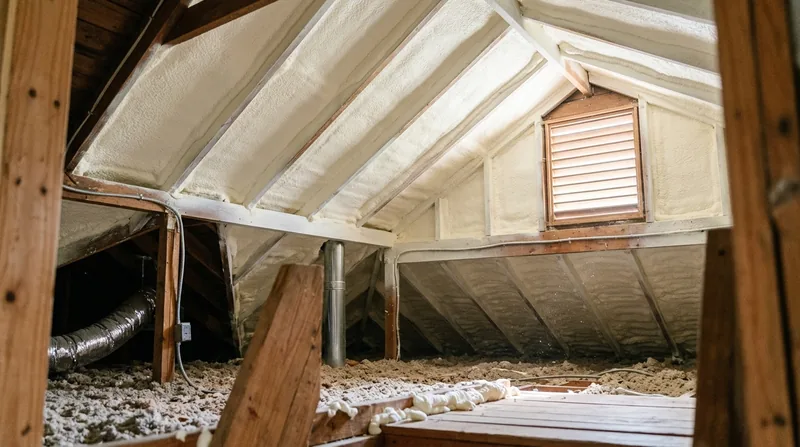




Charlotte's older neighborhoods, from the tree-lined streets of Dilworth and Myers Park to the dense infill of NoDa and South End, sit atop decades-old insulation that has settled, compacted, or failed entirely. Mid-century ranches across Mecklenburg County still carry original attic batts that have lost their R-value, while vented crawl spaces beneath early 1900s bungalows pull in humid summer air year-round. When insulation replacement and re-insulation in Charlotte becomes necessary, the job is not cosmetic: it is the difference between a home that holds temperature and one that bleeds energy into the Piedmont heat and cold. We remove failed insulation and install new spray foam sized to the job, from vented attics in Myers Park to crawl spaces under Plaza Midwood homes, ensuring your home is protected against the climate that actually dominates here. Our work is measured in R-value and thickness, installed with mechanical ventilation during cure, and backed by a clear estimate before we begin.
Why Insulation Replacement Matters in Charlotte's Climate
Charlotte sits in IECC climate zone 3A, where hot humid summers and mild winters with occasional cold snaps create competing moisture pressures. Settled attic insulation no longer blocks summer heat from baking through the roof deck, while damp crawl spaces and uninsulated rim joists become pathways for winter cold to leak into living spaces. When insulation fails, your HVAC system runs longer and harder, and the seasonal swing between cooling load and heating load accelerates wear on equipment. The right replacement insulation is not a retrofit of the same failed material: it is a fresh layer sized to current code and climate, installed in a way that stops air leakage at the same time.
- We remove all failed insulation, debris, and contaminated material before any new foam is installed.
- We air seal rim joists, band joists, rim cavities, and attic rim before insulation coverage begins.
- We specify closed cell or open cell foam based on the moisture profile and use case of each zone.
- We install new insulation to the R-value and thickness required by code at your address and confirmed in writing on the estimate.
Replacement insulation in Charlotte is not optional maintenance: it is the foundation of a home that stays comfortable and efficient through the seasons.
Key info: Many Charlotte homeowners discover their attic insulation has settled to less than half its original R-value after 20 or 30 years. Crawl spaces under older Dilworth and Plaza Midwood homes are often vented directly to outside air, pulling in summer humidity and winter cold. Replacement is the only remedy.
For more on what failed insulation looks like and when removal is the first step, see our insulation removal service page.
How We Handle Insulation Replacement and Re-Insulation in Charlotte
Replacement is a multi-step process that begins with a thorough inspection and removal of the old material. We assess the attic deck or crawl space substrate for moisture, damage, or contamination that would prevent new foam from bonding. Once the space is clear and any moisture issues are addressed, we install new spray foam in controlled passes, maintaining the manufacturer's ratio, drum temperature, and application thickness. We provide mechanical ventilation during cure, establish a clear re-entry window of 24 to 48 hours, and leave you with a written record of R-value, thickness, and coverage area.
- We inspect the attic or crawl space, identify failed insulation, and assess the substrate for moisture or damage.
- We remove all old insulation, debris, and any contaminated material, leaving the deck or rim cavity clean and dry.
- We air seal rim joists, band joists, rim cavities, pipe penetrations, and electrical chases before foam application.
- We apply new spray foam in controlled passes, maintaining proper thickness and coverage per the estimate specification.
- We provide mechanical ventilation during cure and confirm a 24 to 48 hour re-entry window with you in writing.
The result is a home with insulation that actually performs, paired with air sealing that stops the leaks that replacement insulation alone cannot fix.
Example: A 1970s ranch in Mint Hill with a vented attic had R-19 batts that had settled to R-8 over 40 years. We removed the failed material, air sealed the rim, and installed 5.5 inches of open cell foam to R-21, plus sealed all attic rim cavities. The homeowner saw a measurable drop in summer cooling hours within the first month.
Learn more about open cell spray foam and when it is the right choice for attic replacement.
Insulation Replacement Methods: Closed Cell vs. Open Cell
| Approach | Description | Best for |
|---|---|---|
| Closed Cell Replacement | Dense foam at 3.6 to 3.8 pounds per cubic foot, R-6.5 to R-7 per inch, vapor barrier properties, high compressive strength. | Crawl spaces with moisture risk, rim joists, sealed attics, metal buildings, basements with rim band joists. |
| Open Cell Replacement | Light foam at 0.5 to 0.7 pounds per cubic foot, R-3.6 per inch, air-permeable, sound dampening, lower cost per board foot. | Vented attics, garage ceilings, bonus rooms, upper-floor cavities where condensation risk is low. |
| Blown-In Replacement | Loose-fill cellulose or fiberglass applied pneumatically, R-3.5 per inch, no air sealing benefit, lower installation cost. | Top-up of sound attics with no air leakage issues, where the only goal is R-value and budget is the constraint. |
| Injection Foam Replacement | Low-pressure foam injected into closed wall cavities, rim joists, or band joists without demolition, minimal disturbance. | Pre-1980 homes with hollow walls, retrofitting rim joists without opening the foundation, crawl space band joists. |
Each method has a role in Charlotte's climate. Closed cell is the right answer for moisture-prone zones like crawl spaces and rim joists. Open cell is the cost-effective choice for vented attics where condensation risk is low. Blown-in is sometimes the honest answer when a sound attic just needs a top-up. Injection foam is the only way to retrofit hollow walls without tearing into them. We specify the method that matches the job and the budget, not the method that gives us the biggest ticket.
Insulation Replacement and Re-Insulation Cost in Charlotte: What to Expect
Replacement insulation in Charlotte typically starts at $2,800 for a small attic or crawl space zone and rises based on square footage, the foam type selected, and the complexity of air sealing required. A full attic replacement in a 2,000 square foot home usually falls in the $4,500 to $8,000 range, depending on attic height, rim configuration, and whether closed cell or open cell is specified. Crawl space replacement under a Harrisburg or Huntersville ranch often costs $3,500 to $6,500 because of the moisture control requirements and the need to seal rim joists and band joists as part of the job. Multiple estimates are always smart: spray foam work is measured on site at the board foot, and a low estimate with no R-value specification or no mention of air sealing is a signal to look elsewhere.
The factors that move cost are straightforward: the square footage of coverage, the R-value and thickness specified in code at your address, whether the substrate is clean and dry or requires remediation first, and the accessibility of the space for our crew. A vented attic in a one-story home is faster and cheaper than a sealed attic in a two-story colonial with complex rim cavities. A crawl space with standing water or mold growth cannot be insulated until the moisture is fixed or we walk away. Get a written estimate that names the R-value, thickness, square footage, foam type, and any air sealing scope before any work begins.
For detailed pricing on different job types and service areas, visit our pricing overview.
Insulation Replacement and Re-Insulation Near Me: What Charlotte Homeowners Should Know
When you are ready to hire a spray foam insulation contractor for replacement work, verification is your best tool. Ask for a written estimate that specifies R-value, thickness, square footage, and the foam type being used. Request proof of insurance and ask to verify it with the carrier: the contractor's word is not enough. Check references from recent jobs in Charlotte or nearby areas, and ask those homeowners about the re-entry timeline, the smell during cure, and whether the contractor was reachable after the job. If the estimate has no R-value, no thickness, no board foot count, or a price far below market with no detail, that is a signal to keep looking.
- We provide written estimates with R-value, thickness, and board foot specifications before any work begins.
- We are fully insured, and proof of coverage is available on request before the job starts.
- We establish a clear re-entry window of 24 to 48 hours and provide mechanical ventilation during cure.
- We work with your local building department on permits where required and help you understand what applies at your address.
- We are reachable by phone at (980) 217-3281 during and after the job, and we respond to questions about smell, cure time, or performance.
The trade has rig-and-run crews and national franchises, but the local independent shop that gives you a clear estimate, follows the manufacturer's spec, and stays reachable after the job is done is worth the call.
Ready to get started? Contact us for a free estimate with no obligation to book.
The Right Time to Replace Insulation in Charlotte
Replacement insulation is not seasonal in the way that tree work is, but timing matters. Spring and fall are ideal because the weather is mild and mechanical ventilation during cure is easiest to manage. Summer heat can accelerate cure time but also makes attics uncomfortable for our crew. Winter is possible but colder temperatures slow cure and can affect foam application. The real driver is not the calendar but the symptom: if your attic is baking in summer and your crawl space is pulling in humid air, replacement cannot wait. Charlotte's hot humid summers create moisture pressure that drives inward through failed insulation and unsealed rim joists, and delaying replacement means another season of high cooling bills and risk to the structural wood beneath the rim.
Do not wait for an emergency. Call us at (980) 217-3281 to schedule an inspection and estimate, and we will help you time the work to fit your schedule and budget.
Insulation Replacement & Re-Insulation in Charlotte: Pricing Guide
| Service | Price | Details |
|---|---|---|
| Small attic or crawl zone replacement | Starting at $2,800 | Includes removal of old insulation, air sealing, and new foam coverage up to 400 square feet with R-value specified on estimate |
| Full attic replacement (1,500 to 2,500 sq ft) | Starting at $4,500 | Complete removal, rim sealing, and new spray foam with R-value and thickness documented; cost rises with attic height and rim complexity |
| Crawl space replacement with rim joist sealing | Starting at $3,500 | Removal of old insulation, moisture assessment, band joist and rim cavity air sealing, and new closed cell foam coverage per moisture profile |
| Injection foam retrofit of hollow walls or band joists | Starting at $1,200 | Low-pressure foam injected into closed cavities without demolition; cost depends on linear feet and cavity depth |
| Complex or large-scale replacement job | On estimate | Multi-zone jobs, remediation of moisture or contamination, or non-standard substrates require on-site inspection before pricing |
| Free estimate and consultation | No charge | Response within 24 hours at (980) 217-3281; includes site walk, assessment, and written estimate with no obligation to book |
Indicative pricing, the exact cost depends on square footage, finish, and site access. Free personalized estimate within 24h at (980) 217-3281.


