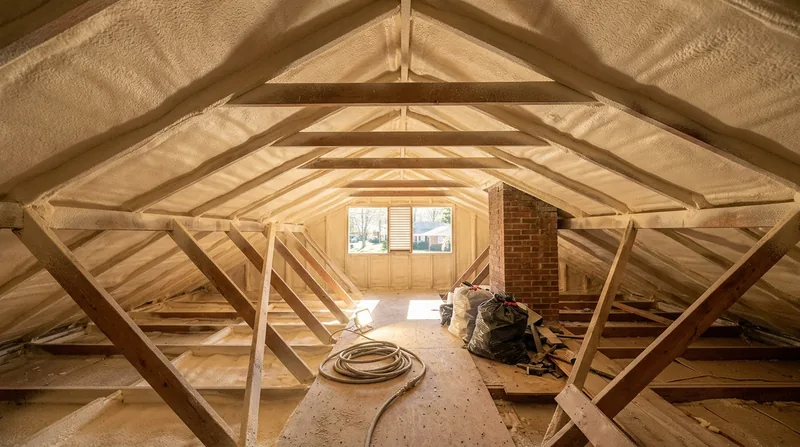




Charlotte attics bake under the Piedmont sun each summer, pushing cooling bills up fast. Attic spray foam insulation in Charlotte seals out humidity and cuts heat gain year round by spraying foam directly to the roof deck in mid-century ranches and newer Matthews builds. Whether your home sits in the tree-lined streets of Dilworth, the dense infill of NoDa, or the postwar ranch blocks that ring the urban core, hot attics drive summer cooling costs higher every year. We spray closed cell and open cell foam to the underside of the roof sheathing, creating a sealed thermal and moisture barrier that stops the humid Piedmont air from leaking into your living space. A properly sealed attic also stops winter cold snaps from stressing your upper floors and bonus rooms. Call us at (980) 217-3281 for a free estimate, or read about our air sealing work to understand how we seal the gaps that fiberglass alone cannot.
Why Attic Spray Foam Insulation Matters in Charlotte's Hot, Humid Climate
Charlotte sits in IECC climate zone 3A, where hot humid summers push inward through attics and wall cavities, and mild winters still bring cold snaps that stress uninsulated rim joists and band joists. The Piedmont sun bakes down on attics in mid-century ranches across Mecklenburg County and newer subdivisions pushing toward Matthews and Huntersville, driving attic temperatures well over 130 degrees Fahrenheit on summer afternoons. That heat radiates down through the ceiling into your living space, forcing your air conditioning to run harder and longer. Vented attics with settled or thin fiberglass insulation cannot stop that heat gain, and they allow humid summer air to condense on cool surfaces inside the attic, creating the moisture conditions that lead to wood rot and mold. A sealed attic with spray foam stops both the heat and the humidity.
- Spray foam seals the roof deck and all penetrations, stopping hot air from leaking down into your home during summer cooling season.
- A sealed attic eliminates the temperature differential that causes moisture to condense on roof sheathing and framing.
- Closed cell foam provides high R-value per inch and acts as a vapor barrier, critical in Charlotte's humid climate.
- Open cell foam is lower cost and still delivers strong air sealing while allowing the roof deck to dry if moisture enters from above.
- Sealed attics reduce the load on your air conditioning system, lowering electric bills throughout the cooling season.
These benefits add up to lower cooling bills, longer roof life, and better comfort in your upstairs rooms year round.
Key info: Charlotte's climate pushes humid air inward during summer and cold air downward in winter. A sealed attic with spray foam stops both, which is why this job is the highest-value retrofit in the Piedmont. See the North Carolina Building Code and your local building department for attic ventilation and thermal barrier rules that apply at your address.
How We Spray Foam Your Attic: The Process in Charlotte
We start with a free on-site estimate where we measure your attic, identify all air leaks and thermal bypasses, and determine whether closed cell or open cell foam is the right choice for your home. We specify the R-value and thickness you need in writing, so you know exactly what you are getting before we start. On the day of the job, we set up mechanical ventilation to manage odor and VOCs during the spray, then apply foam in controlled passes to the underside of your roof sheathing, sealing rim board gaps, electrical chases, and every penetration where air leaks out. Once the foam cures, we verify coverage and thickness, then remove ventilation equipment. Most homeowners see results on their next cooling bill.
- We arrive with equipment and conduct a final walkthrough to identify all air leak points and confirm your attic layout.
- We set up mechanical ventilation fans to pull air and odor out of the attic during spray and cure.
- We apply foam in thin passes to the roof deck, building to your specified R-value and thickness.
- We seal rim board gaps, electrical chases, and ductwork penetrations as we go.
- We remove ventilation equipment once the foam has cured and we have verified full coverage.
- You wait 24 to 48 hours before re-entering the attic, giving the foam time to fully cure.
This process takes one to three days depending on attic size and complexity, and leaves your attic sealed tight against summer heat and winter cold.
Example: A 1,500-square-foot ranch in Mint Hill with a vented attic and R-19 fiberglass that has settled flat over 30 years typically needs 5.5 to 6.5 inches of closed cell foam to reach R-38 to R-40 under the roof deck. We spray in two to three passes over a morning and early afternoon, seal all penetrations, then remove ventilation fans by late afternoon. The homeowner stays out of the attic for 48 hours while the foam cures. See our closed cell spray foam page for more detail on R-value and performance.
| Approach | Description | Best for |
|---|---|---|
| Closed Cell Spray Foam | High-density foam at 3.5 to 4.5 lbs per cubic foot, R-6.5 to R-7 per inch, acts as a vapor barrier, resists moisture intrusion. | Attics in humid climates, sealed roof decks, condensation control, maximum R-value in minimal thickness. |
| Open Cell Spray Foam | Lower-density foam at 0.5 to 1.5 lbs per cubic foot, R-3.5 to R-3.8 per inch, allows vapor transmission, lower cost per board foot. | Attics where vapor control is not critical, sound dampening, budget-conscious retrofits, vented attics that can dry to the outside. |
| Blown-In Fiberglass Top-Up | Loose-fill fiberglass added over existing insulation, R-2.5 to R-3.2 per inch, no air sealing, lowest cost per R-value. | Attics with sound existing insulation that just needs depth added, vented attics with no moisture concern, budget-first projects. |
| Insulation Removal and Replacement | Tear out failed, settled, or contaminated insulation, then spray foam or blown-in to new R-value, includes attic cleanup. | Attics with old, settled, or damaged insulation, rodent droppings or contamination, mold concerns, complete retrofit to current code. |
Attic Spray Foam Insulation Cost in Charlotte: What to Expect
Attic spray foam insulation in Charlotte typically starts at $1.50 to $2.50 per square foot for closed cell foam applied to the roof deck, depending on attic size, access, existing insulation condition, and whether you need removal of old material. Open cell foam runs lower, starting around $0.90 to $1.40 per square foot. A typical 1,500-square-foot attic in a mid-century ranch across Mecklenburg County costs $2,250 to $3,750 for closed cell to R-38 to R-40 under the roof deck. The price moves up if your attic has poor access, complex framing with many penetrations, or old insulation that must be removed first. We provide a written estimate with R-value, thickness, and total square footage specified, so you know exactly what the job costs before we start.
Getting two or three estimates from local contractors is smart because pricing varies based on how each crew measures attic size, accounts for waste and overspray, and prices labor. A low estimate with no R-value and thickness specification, no mechanical ventilation during cure, and immediate re-entry promised is a red flag. Visit our pricing page for more detail on what moves the cost up or down, and call us at (980) 217-3281 for your free estimate.
Attic Spray Foam Insulation Near Me: What Charlotte Homeowners Should Know When Hiring a Contractor
When you are looking for a spray foam contractor near Charlotte, verify that the company is fully insured with general liability and workers compensation, and ask to see a current certificate of insurance. Check references from recent jobs in your area, and ask those homeowners about the quality of the work, the professionalism of the crew, and whether the contractor was reachable if questions came up after the job. Get a written estimate that includes R-value, thickness, and total square footage, not just a price per board foot. Ask about the manufacturer and system being used, the re-entry window after spray, and how ventilation will be managed during cure. If your home is in a master-planned community with an HOA, check your architectural guidelines to see if exterior work on attic vents or roof-mounted equipment requires approval. Permits for spray foam insulation in attics vary by city within Greater Charlotte, so ask your contractor how permitting works at your address and whether a final inspection is required. Call us at (980) 217-3281 or visit our contact page to get a free estimate and ask any questions about how we work.
A local contractor with a local address and local plates, who can be reached by phone the week after the job is done, is worth more than the lowest bid from a rig-and-run crew passing through town. We have been in business since 2015, and we are fully insured. We provide written estimates with all specs included, and we manage mechanical ventilation during every spray to control odor and VOCs. Our crews follow the manufacturer's ratio and drum temperature, apply foam in controlled thickness per pass, and specify a 24 to 48 hour re-entry window so the foam cures properly. That is the standard of work that makes the difference between a job that performs for 20 years and one that fails in five.
Attic Spray Foam Insulation in Charlotte: Pricing Guide
| Service | Price | Details |
|---|---|---|
| Closed Cell Spray Foam Attic | Starting at $1.50/sq ft | R-6.5 to R-7 per inch, full air sealing, vapor barrier control, humidity-critical Charlotte attics, sealed roof decks |
| Open Cell Spray Foam Attic | Starting at $0.90/sq ft | R-3.5 to R-3.8 per inch, strong air sealing, vapor-permeable, vented attics, lower cost entry point for sealed attics |
| Insulation Removal and Replacement | On estimate | Tear-out of settled, contaminated, or failed insulation plus new spray foam or blown-in, attic cleanup included, scope drives price |
| Travel | Included | Charlotte, Pineville, Matthews, Mint Hill, Stallings, Belmont, Mount Holly, Harrisburg, Huntersville, and surrounding areas |
| Free Estimate | No obligation | Written specs with R-value, thickness, and square footage, response within 24 hours, call (980) 217-3281 |
Indicative pricing, the exact cost depends on square footage, finish, and site access. Free personalized estimate within 24h at (980) 217-3281.


