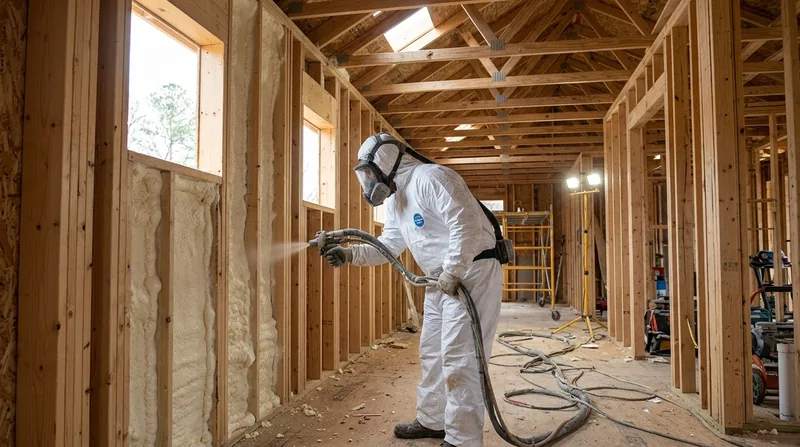




Commercial and New Construction Spray Foam in Charlotte means insulation that goes in before the drywall, when the framing is still open and the builder is on schedule. From commercial shells in South End and NoDa to frame subdivisions pushing toward Matthews and Huntersville, new construction is where spray foam delivers its fastest return: no demolition, no existing insulation to remove, no moisture trapped behind walls. Charlotte's climate zone 3A brings hot humid summers and occasional winter cold snaps, so builders who specify closed cell or open cell foam before drywall goes up avoid the vented attic failures and humid crawl space leaks that plague retrofit work. We work with builders on their timeline and to their specs, turning framing into a sealed thermal envelope that holds its R-value for the life of the building.
Why New Construction Spray Foam Matters in Charlotte's Building Market
New construction in Greater Mecklenburg County spans two main profiles: multi-story frame subdivisions with vented attics, bonus rooms, and slab foundations, and commercial shells where the mechanical and envelope go in before tenants arrive. Both face the same thermal problem: Charlotte summers push 90 degrees for weeks at a time, and humid air loads into any cavity that is not sealed. A vented attic in a new two-story over Matthews or Huntersville will bake under the Piedmont sun all July and August, driving cooling bills up and creating a moisture gradient that pulls humid outside air inward whenever the AC shuts down. Closed cell foam sprayed to the underside of the roof deck before sheathing and shingles eliminate that cycle entirely. Open cell foam in an attic or interior wall costs less and still delivers the air seal that fiberglass batts cannot match. Commercial shells benefit from closed cell on the exterior rim and band, sealing the thermal break at the slab edge where condensation forms on metal studs in winter.
- We spray closed cell foam to roof decks before shingles, creating a sealed attic that stays dry year-round.
- We apply open cell foam to interior cavities in frame walls, delivering R-value and acoustic dampening at a lower cost than closed cell.
- We insulate band joists and rim joists on slab foundations before concrete is poured, blocking the thermal leak that drives winter heating loads.
- We seal mechanical penetrations, rim details, and band board transitions that fiberglass and blown-in insulation leave open.
- We coordinate with the builder's schedule, spraying before drywall, MEP rough-in, or exterior closure so no framing delay occurs.
Builders who specify foam insulation before framing is closed achieve better thermal performance, lower utility costs for the first owner, and fewer callbacks for comfort and moisture issues.
Local context: New subdivisions in Huntersville, Matthews, and Indian Trail are framed with 2x6 exterior walls and vented attics designed for blown-in fiberglass. A sealed attic with closed cell foam under the roof deck costs 30 to 40 percent more than blown-in but eliminates the attic condensation and mold risk that develops in humid summers when the AC cycles off. Commercial shells in Charlotte's urban core (South End, NoDa, Plaza Midwood) use metal stud framing on concrete slabs, where spray foam on the rim and band is the only way to stop the thermal break and condensation pooling that ruins drywall and mechanical equipment.
For a detailed overview of Charlotte's building code requirements for new construction insulation, consult the City of Charlotte Building Inspections and Permits office, which enforces the North Carolina Building Code and IECC standards for your address.
How We Insulate New Construction in Charlotte: From Framing to Drywall
New construction spray foam is a sequence, not a single step. The builder's schedule dictates when we arrive, and our work fits into the framing-to-drywall window. We start with a walk-through to identify all cavities, thermal breaks, and mechanical penetrations that need sealing. We confirm the foam type and R-value required by the builder's specification and the energy code for your address. We then spray the roof deck, band joists, rim details, and any interior walls that are in the scope, using either closed cell for maximum R-value and moisture resistance or open cell for cost efficiency and sound control. After cure, the framing is ready for MEP rough-in and drywall. No surprises, no delays.
- We confirm the builder's specification for foam type, R-value, and thickness on the first site visit.
- We spray roof decks and band joists before sheathing or concrete pour, creating a sealed envelope before the building is closed.
- We seal all mechanical penetrations, rim transitions, and band board details that standard framing leaves open.
- We provide a written estimate with R-value and thickness specs, plus a timeline that fits the builder's schedule.
- We coordinate re-entry timing with the builder so drywall, HVAC, and electrical rough-in can proceed on schedule.
The result is a building that holds its thermal envelope and avoids the moisture and comfort issues that plague vented attics and uninsulated rims in Charlotte's climate.
Charlotte example: A 12-unit residential subdivision in Stallings with 2x6 frame walls, vented attics, and slab foundations. Spray foam on the roof deck and band joists before framing closure cost the builder an additional 3 to 4 percent of the total build price but delivered an 8 to 10 percent reduction in year-one utility costs for the first owner, a selling point that justified the premium. No attic moisture, no rim condensation, and no callbacks for comfort issues in the first summer.
For more detail on how spray foam performs in sealed attics and closed cavities, see our page on closed cell spray foam insulation, which covers the technical specs and performance data builders rely on.
New Construction Spray Foam Methods and Applications
| Approach | Description | Best For |
|---|---|---|
| Closed Cell Spray Foam | High-density foam applied to roof decks, band joists, and rim details. Provides R-value 6.5 to 7 per inch, stops air and moisture infiltration, hardens to rigid shell. | Sealed attics in frame homes, commercial rim and band on slab, metal building condensation control, any application where moisture or air infiltration is the primary risk. |
| Open Cell Spray Foam | Lower-density foam applied to interior cavities and walls. Provides R-value 3.5 to 4 per inch, absorbs sound, remains slightly flexible, cures lighter and faster than closed cell. | Interior frame walls in residential and light commercial, bonus rooms, any cavity where cost and sound dampening matter more than maximum R-value. |
| Roof Deck Sealing | Closed cell foam sprayed to the underside of roof sheathing before shingles, creating an unvented (sealed) attic that eliminates moisture and temperature swings. | New frame construction with vented attic framing, any two-story home in Charlotte where summer cooling and winter heating efficiency is a priority. |
| Band and Rim Joist Sealing | Closed cell foam applied to the rim band on slab foundations, blocking the thermal break and condensation point where the foundation meets the frame. | All new construction on slab in Charlotte, commercial buildings, any foundation detail where winter cold or summer humidity drives condensation. |
| Mechanical Penetration Sealing | Spray foam applied around HVAC ducts, electrical conduit, plumbing penetrations, and other openings that standard framing leaves unsealed. | Any new construction where air sealing is required by code or where the builder wants to eliminate air leakage at rough-in penetrations. |
Commercial and New Construction Spray Foam Cost in Charlotte: What to Expect
New construction spray foam is priced per board foot (one square foot, one inch thick), and the cost depends on the foam type, the coverage area, and the complexity of the application. Closed cell foam costs more per board foot than open cell because it delivers higher R-value and provides a moisture barrier. A sealed attic on a 2,000-square-foot new home with 6 inches of closed cell foam will run higher than the same home with 4 inches of open cell in interior walls. Commercial projects with large roof decks or extensive rim details may qualify for volume pricing. We provide a free commercial estimate that includes R-value and thickness specs so you know exactly what you are paying for and why.
The best way to understand cost is to compare estimates from multiple contractors. We encourage builders and property managers to get two or three quotes so they can see how thickness, R-value, and foam type affect the final price. For a detailed breakdown of pricing factors and typical ranges, visit our pricing overview page.
Call us at (980) 217-3281 for a free estimate. We will walk the site, confirm the builder's specs, and provide a written price with R-value and thickness so there are no surprises at invoice.
What to Look for When Hiring a Spray Foam Contractor Near Charlotte for New Construction
Hiring the right spray foam contractor for new construction means checking three things: insurance, references, and the estimate itself. Ask any contractor for proof of general liability and workers compensation insurance. Request the names of three recent builders or commercial projects they have completed, and call those references to confirm the work was done on time and to spec. The estimate should always include R-value and thickness in writing, the foam type (closed cell or open cell), the total board footage, and the timeline. If a contractor quotes a price without those details, or promises immediate re-entry or same-day cure, walk away. Spray foam requires 24 to 48 hours of mechanical ventilation after application, and re-entry before that window creates off-gassing and safety risks.
Permitting varies by city across Greater Charlotte. The Charlotte Building Code and IECC energy code govern insulation specs for your address, and the building department has the final say on what is required. We help navigate what applies to your project, but the builder or property manager is responsible for confirming permit and registration requirements with the local building department. For new commercial construction, check whether your HOA or master-planned community has architectural rules that govern exterior work or mechanical systems. North Carolina 811 utility locates are required by law before any excavation, but spray foam insulation work rarely involves digging, so this is not typically a factor.
Contact us at our contact page to request a free estimate and discuss your builder's specs and timeline.
Commercial & New Construction Spray Foam in Charlotte: Pricing Guide
| Service | Price | Details |
|---|---|---|
| Free Commercial Estimate | Free | Includes R-value, thickness, board footage, foam type, and timeline for any new construction project |
| Closed Cell Spray Foam (Roof Deck, Band Joist) | Starting at $1.50-$2.25 per board foot | Varies by thickness required, coverage area, and site access; sealed attic and rim sealing are primary applications |
| Open Cell Spray Foam (Interior Walls, Bonus Rooms) | Starting at $0.85-$1.35 per board foot | Lower cost than closed cell; used for interior cavities where sound dampening and cost efficiency matter most |
| Large Commercial Shell or Multi-Unit Project | On Estimate | Volume pricing available; requires site visit to confirm roof deck area, rim and band details, and mechanical penetration count |
| Travel and Scheduling | Included | No mileage fee or travel charge in Charlotte and surrounding areas; fits builder's timeline and framing schedule |
Indicative pricing, the exact cost depends on square footage, finish, and site access. Free personalized estimate within 24h at (980) 217-3281.


