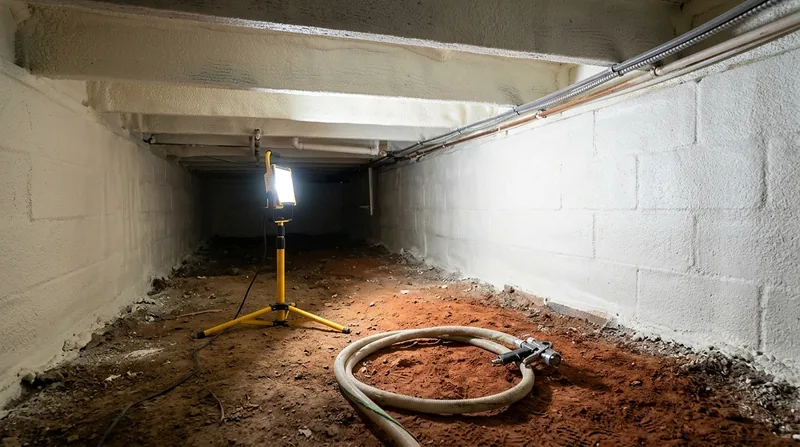




Vented crawl spaces beneath Charlotte's older homes are a year-round moisture problem. The red clay foundation that sits under Mecklenburg County's early 1900s bungalows, brick homes and mid-century ranches allows damp air to seep inward all summer long, and winter cold snaps stress the band joist area where the rim board meets the foundation wall. Crawl Space Spray Foam Insulation in Charlotte seals those moisture pathways by spraying closed cell foam across the walls and band joist, blocking humid outside air before it enters the home and creating a thermal and moisture barrier that holds year-round. We have been doing this work since 2015 across Charlotte, Pineville, Matthews, Mint Hill and the surrounding counties. The result is lower humidity in the living space above, reduced mold risk, and lower heating and cooling costs. This page explains how the work is done, what it costs, and what to look for when hiring a contractor.
Why Crawl Space Spray Foam Insulation Matters in Charlotte's Humid Climate
Charlotte sits in IECC climate zone 3A, where hot humid summers push moisture pressure inward through every unsealed surface. A vented crawl space is an open door: outside air enters through foundation vents, cools when it hits the cold rim joist in winter, and deposits moisture on wood framing. In summer, the same humid air supports mold growth on band joists and rim boards. Older homes in Dilworth, Myers Park, NoDa and South End often have original vented crawl spaces with no insulation, and mid-century ranches across Mecklenburg County still pull damp air year-round. Spray foam stops that cycle by sealing the walls and band joist area, so outside air cannot enter the crawl space at all.
- We seal the rim joist and band joist area first, the highest-priority moisture entry point where the foundation wall meets the house frame.
- We spray closed cell foam across the crawl space walls down to the footer, creating a vapor barrier that stops humid air from entering the foundation.
- We close off foundation vents so conditioned air stays in the crawl space instead of being drawn outside.
- The sealed crawl space becomes a conditioned buffer zone that reduces heating and cooling load on the floors above.
A sealed crawl space is the foundation of a dry, efficient home in Charlotte's climate.
Key info: North Carolina building code allows sealed crawl spaces when spray foam insulation is installed correctly with mechanical ventilation during cure and a stated re-entry window of 24 to 48 hours. Your local building department in Charlotte, Pineville, Matthews or your city governs what applies at your address. We help you navigate what the code requires at your location.
For more details on how moisture and insulation interact, see our page on Air Sealing in Charlotte.
How We Spray Foam a Crawl Space in Charlotte: Step by Step
A crawl space spray foam job starts with a walkthrough to check for water, standing moisture, or active leaks. If the crawl space is wet or has standing water, we stop and defer to the homeowner to address the source first. We do not spray over wet substrates. Once the space is dry, we set up temporary ventilation so curing foam fumes can exit safely, and we establish a re-entry window so the homeowner knows when the space is safe to occupy again. The actual spray work takes a few hours, and the foam cures fully in 24 to 48 hours depending on temperature and humidity.
- We inspect the crawl space for water, standing moisture, roof leaks or plumbing leaks and defer those repairs to the homeowner or a licensed contractor before we spray.
- We set up mechanical ventilation during the spray and cure process so fumes exit safely and air quality stays within safe limits.
- We spray closed cell foam across the walls starting at the rim joist, working downward in controlled passes to the footer.
- We seal rim board and band joist cracks with foam, and we close off or insulate foundation vents so the crawl space becomes a sealed, conditioned zone.
- We provide a written estimate with R-value and thickness specifications so you know exactly what you are getting.
The entire process is documented and you receive a completion report with photos and specifications.
Example: A 1950s ranch in Matthews with a vented crawl space and damp rim joist: we seal the rim and band joist area with closed cell foam, spray the foundation walls to the footer, and close the vents. The homeowner sees lower humidity in the basement or first floor within the first heating season, and the crawl space stays dry year-round.
To learn more about closed cell foam and why it is the right choice for crawl spaces, visit our Closed Cell Spray Foam page.
Crawl Space Spray Foam Methods and Materials
| Approach | Description | Best for |
|---|---|---|
| Closed Cell Foam, Walls and Band Joist | Two-pound closed cell spray foam applied to foundation walls and rim joist, creating a continuous vapor barrier and air seal. Typical thickness 1.5 to 2 inches. | Sealed crawl spaces in humid climates where moisture control is the priority. Charlotte and surrounding counties. |
| Rim Joist and Band Joist Sealing | Closed cell foam applied to the rim board and band joist interface where the house frame meets the foundation. Seals cracks and gaps that pull in outside air and moisture year-round. | Any crawl space, basement or rim joist retrofit. Single highest-value moisture and air sealing target in older homes. |
| Foundation Vent Closure | Foam or rigid foam board seals foundation vents so humid outside air cannot enter the crawl space. Vents remain closed once the space is sealed and conditioned. | All sealed crawl space projects. Required to maintain the moisture barrier and prevent re-entry of humid air. |
| Wall-to-Footer Sealing | Continuous closed cell foam from the rim joist down the foundation wall to the footer, sealing the entire perimeter. Blocks moisture entry through foundation cracks and gaps. | Crawl spaces with active moisture problems or high humidity. Older homes built on red clay in Mecklenburg County and surrounding areas. |
Crawl Space Spray Foam Insulation Cost in Charlotte: What to Expect
Crawl space spray foam insulation in Charlotte typically starts at $2,500 to $3,500 for a small to medium crawl space with straightforward access and no moisture remediation required. The cost depends on the size of the space, the linear feet of rim joist and band joist, access difficulty, and whether the crawl space is already dry or requires moisture work first. A larger crawl space or one with difficult access, low headroom, or obstructions like HVAC equipment or plumbing can run higher. We always provide a written estimate with R-value and thickness specifications so you know exactly what is included before any work begins.
- Rim joist and band joist sealing is the highest-priority target and often the best return on investment for moisture control.
- Linear feet of foundation wall to be sealed, combined with rim joist length, determines the volume of foam and labor hours required.
- Access and headroom affect spray time: a tight crawl space with 18 inches of headroom takes longer and costs more than one with 3 feet of clearance.
- If the crawl space has water or high humidity from a plumbing leak or roof leak, those issues must be addressed first before we spray.
- Getting 2 to 3 estimates from local contractors helps you understand the scope and compare pricing fairly.
For a detailed pricing breakdown and examples, visit our Pricing page.
What to Look for When Hiring a Spray Foam Insulation Contractor Near Me in Charlotte
Hiring a local spray foam contractor is a decision that affects your home's moisture control, energy efficiency and indoor air quality for years. The right contractor will give you a written estimate with R-value and thickness, explain the process clearly, carry full insurance, and be reachable after the job is done. The wrong contractor will quote a price with no specs, promise immediate re-entry, use no mechanical ventilation during cure, and disappear when the smell does not go away. Here is what to verify before you hire.
- Ask for a written estimate that includes R-value per inch, thickness, linear feet of rim joist and band joist, and the type of foam being used.
- Verify the contractor is fully insured and ask to see a current certificate of insurance naming you as an additional insured.
- Ask how mechanical ventilation is handled during cure and what re-entry window is promised (24 to 48 hours is the honest answer).
- Call 2 to 3 previous customers and ask about smell, curing time, and whether the contractor was reachable after the job finished.
- If your home is in an HOA with architectural rules, confirm the contractor understands any restrictions on exterior work or crawl space modifications.
- Check with your local building department to understand what permits or inspections apply at your address in Charlotte, Pineville, Matthews or your city.
For a free, no-obligation estimate and to discuss your crawl space, contact us at (980) 217-3281.
Seasonal Timing for Crawl Space Spray Foam in Charlotte
Spring and fall are the best times to spray foam a crawl space in Charlotte. Spring (March through May) offers mild temperatures and lower humidity, which speeds curing and keeps curing fumes manageable. Fall (September through November) brings the same conditions. Summer (June through August) is possible but more difficult: high humidity and heat slow curing and make mechanical ventilation more demanding, so the re-entry window stretches longer. Winter (December through February) is the worst time. Cold temperatures slow curing dramatically, and the temperature swings between heated crawl spaces and cold outside air create condensation risk. If you notice moisture problems in your crawl space in summer, schedule the spray work for early fall when conditions are optimal.
The moisture pressure in Charlotte's vented crawl spaces is highest in summer, so that is when homeowners notice the problem. The smart move is to address it in fall when weather cooperates, so the sealed crawl space is ready before the next humid season arrives.
Crawl Space Spray Foam Insulation in Charlotte: Pricing Guide
| Service | Price | Details |
|---|---|---|
| Small crawl space, rim joist and band joist seal | Starting at $2,500 | Up to 500 linear feet of rim joist and band joist, closed cell foam, straightforward access, no moisture remediation required |
| Medium crawl space, walls and rim joist | Starting at $3,500 | 500 to 800 linear feet of rim joist and foundation wall, closed cell foam, standard access, dry substrate, includes vent closure |
| Large crawl space or difficult access | On estimate | Over 800 linear feet, low headroom, obstructions, water remediation, or complex layout requires site inspection for accurate pricing |
| Travel and setup | Included | No separate mileage or travel fee within Charlotte, Pineville, Matthews, Mint Hill and surrounding service areas |
| Free written estimate | No obligation | Response within 24 hours, includes R-value and thickness specifications, (980) 217-3281 |
Indicative pricing, the exact cost depends on square footage, finish, and site access. Free personalized estimate within 24h at (980) 217-3281.


