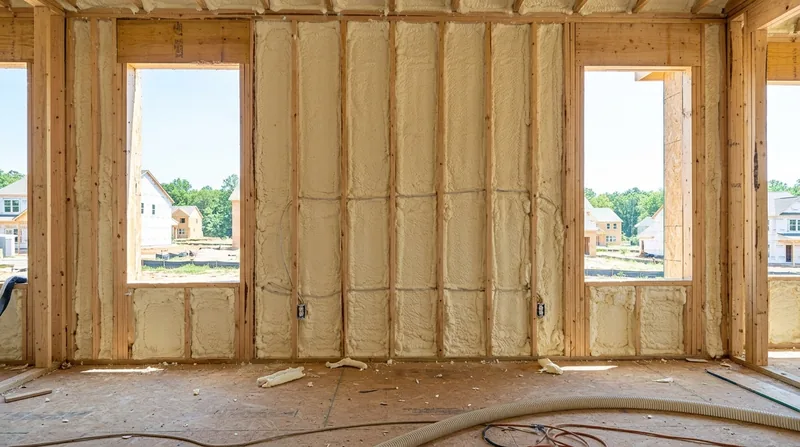




Open Cell Spray Foam Insulation in Charlotte fills the cavities in attics and walls across the Piedmont with a lightweight, sound-dampening foam that expands to seal air leaks without the weight penalty of closed cell. Charlotte's mix of early-1900s bungalows in Dilworth and Myers Park, mid-century ranches across Mecklenburg County, and newer two-story frames pushing toward Matthews and Huntersville all benefit from open cell's ability to reach tight spaces and deaden sound transmission between floors. The region's hot, humid summers drive cooling bills upward through vented attics that bake under the sun, while open cell foam seals those leaks and keeps conditioned air where it belongs. Unlike closed cell, which carries a higher R-value and resists moisture, open cell is the right choice when weight matters, sound control matters, or budget is a real factor on a straightforward attic retrofit. We spray open cell foam with mechanical ventilation during cure, follow the manufacturer's ratio and drum temperature, and give you a clear re-entry window so you know when the space is safe. Learn more about how we approach attic spray foam insulation across the greater Charlotte area.
Why Open Cell Foam Matters in Charlotte's Hot, Humid Climate
Charlotte sits in IECC climate zone 3A, where summer heat and humidity are the dominant pressure on home energy use. A vented attic in a Myers Park bungalow or a Huntersville ranch can reach 140+ degrees on a July afternoon, and that heat radiates down through the ceiling all day, forcing air conditioning to run harder and longer. Fiberglass batts that have settled flat over decades, or gaps left by partial coverage, let that conditioned air leak out and hot outside air leak in. Open cell foam expands to fill every gap, seals the attic floor completely, and eliminates the convection cycle that makes vented attics so expensive to cool. It also dampens sound, which matters in newer subdivisions where bonus rooms over garages and second-story bedrooms sit directly above living spaces.
- Seals air leaks that fiberglass batts miss, especially around rim joists, ductwork penetrations, and electrical boxes.
- Reduces cooling load by preventing hot attic air from radiating down into conditioned spaces during summer.
- Dampens noise transmission between floors, a key benefit in two-story homes and bonus room layouts.
- Lighter than closed cell foam, so it does not add structural load to existing attic framing.
- Expands fully after application, filling odd-shaped cavities and corners that blown-in fiberglass cannot reach.
These benefits add up to lower cooling bills, quieter rooms, and a more durable attic envelope that does not settle or compress over time.
Key info: A 2,000-square-foot Charlotte ranch with a vented attic and settled fiberglass typically loses 20 to 30 percent of its conditioned air through the attic floor and rim joists. Open cell foam seals those leaks, and homeowners typically see measurable cooling bill reductions, especially in July and August when the attic temperature differential is greatest.
For more detail on how permitting and thermal barrier requirements work in Charlotte, see the City of Charlotte building permits page.
How We Install Open Cell Spray Foam in Charlotte Homes
We start with a site visit to assess the attic or wall cavity, measure square footage, identify any existing insulation or contamination, and confirm that the substrate is dry and ready for foam. We then set up mechanical ventilation to exhaust fumes during application, establish a clear work perimeter, and spray open cell foam in controlled passes to build the specified thickness. The foam expands rapidly, fills gaps, and cures over 24 to 48 hours. We do not re-enter the space or allow occupant re-entry until that window has passed and we have confirmed cure completion. Our crews follow the foam manufacturer's specifications for drum temperature, mix ratio, and application pressure, and we document R-value and thickness on every job.
- We inspect the attic or wall cavity and confirm the substrate is dry, clean, and ready for foam application.
- We install temporary mechanical ventilation to exhaust isocyanate fumes and VOCs during spray and initial cure.
- We spray open cell foam in passes no thicker than 3.5 inches per application to ensure proper expansion and density.
- We document the final R-value and foam thickness on a work summary and provide it to you with the invoice.
- We establish a 24 to 48 hour re-entry window and confirm cure before you occupy the space.
This process ensures that the foam is installed correctly, that cure is complete, and that you have a written record of what was done.
Example: A two-story home in Pineville with an unvented attic and existing blown-in fiberglass that has settled to R-15 over 20 years. We remove the old insulation, air seal rim joists and band joists with open cell foam, then spray 5.5 inches of open cell foam across the attic floor to achieve R-19. The job takes one day, mechanical ventilation runs overnight, and the space is ready for normal use by the next afternoon.
See our detailed process for insulation removal and preparation before any foam retrofit.
| Approach | Description | Best for |
|---|---|---|
| Open Cell Attic Retrofit | Remove old insulation, air seal rim joists and framing gaps, spray 5 to 6 inches of open cell foam across attic floor to achieve R-19 to R-21. | Mid-century ranches and older bungalows with settled fiberglass and air leaks; weight is not a concern; sound dampening is a benefit. |
| Open Cell Wall Cavity Fill | Drill small holes in exterior wall sheathing and inject open cell foam into stud bays to fill voids and seal air leaks; repair holes and repaint. | Pre-1980 homes with empty wall cavities; retrofit without interior demolition; improves sound control and thermal resistance without major construction. |
| Open Cell Bonus Room or Over-Garage Ceiling | Spray open cell foam against the roof deck or sloped ceiling to seal air leaks and create a conditioned attic space; lighter than closed cell so framing load is minimal. | Newer subdivisions in Matthews and Huntersville where bonus rooms and second-story additions sit over garages or unvented attics; sound dampening between floors is valued. |
| Open Cell Rim Joist and Band Joist Sealing | Spray open cell foam into the rim and band joist cavity to seal air leaks and block outdoor air infiltration into the basement or crawl space. | Homes in Charlotte and surrounding counties with basement or crawl space rim joists; reduces winter heating loss and summer cooling bypass; improves comfort on upper floors. |
Open Cell Spray Foam Insulation Cost in Charlotte: What to Expect
Open cell spray foam typically starts at $0.55 per board foot for straightforward attic applications in Charlotte, with the final cost determined by access, existing insulation removal, substrate preparation, and the total square footage of the space. A 1,500-square-foot attic retrofit that requires removal of old fiberglass, air sealing of rim joists, and 5.5 inches of open cell foam across the floor will cost more than a simple top-up of an empty attic, and a two-story wall cavity fill with injection foam will have a different price structure than an attic spray. Factors that move cost upward include difficult attic access (knee walls, tight framing, low headroom), extensive substrate preparation, multiple stories or complex geometry, and the need to remove and dispose of existing insulation or contaminated material. We provide a written estimate that specifies R-value, thickness, coverage area, and the total board feet we will spray, so you know exactly what you are paying for before we start.
Getting 2 to 3 estimates from different contractors is smart practice. Compare the R-value and thickness each one proposes, not just the price. A bid that does not specify R-value or thickness is a red flag. See our full pricing overview for more detail on what drives cost and how we structure estimates.
We do not offer financing or rebate processing, but open cell spray foam insulation qualifies for the federal energy efficiency tax credit under current IRS rules. Verify eligibility with your tax professional or the IRS website before you decide.
What to Look for When Hiring a Spray Foam Insulation Contractor Near Me in Charlotte
Hiring the right spray foam contractor is as important as the product itself. A poorly installed foam job can smell for weeks, leave gaps that defeat the purpose, or cure improperly and lose R-value. Start by verifying that the contractor is fully insured and can provide a certificate of insurance on request. Ask for references from recent jobs in your area, and call at least two of them to ask about the quality of the work, whether the job stayed on schedule, and whether there were any issues after completion. Get a written estimate that includes R-value, foam thickness, coverage area, and board footage, and compare it to 2 or 3 other bids. Be skeptical of estimates that are far below market or that do not include those specifications.
- Verify that the contractor is fully insured for spray foam work and can provide a current certificate of insurance.
- Ask for at least two local references and contact them to confirm quality, timeline, and post-job satisfaction.
- Get a written estimate that specifies R-value, foam thickness in inches, total square footage, and board feet to be sprayed.
- Confirm that the contractor will use mechanical ventilation during spray and cure, and will establish a clear re-entry timeline of 24 to 48 hours.
- Check whether the contractor holds any certifications from foam manufacturers or trade associations, and ask to see documentation if they claim one.
- Ask about the contractor's experience with Charlotte's climate and building stock, and whether they have completed similar jobs in your neighborhood.
If your home is in a master-planned community or HOA, check the architectural guidelines before you book, as some associations have rules about exterior work or attic venting. Contact the Charlotte Spray Foam Insulation team to discuss your project and get a free estimate with no obligation.
Open Cell Spray Foam Insulation in Charlotte: Pricing Guide
| Service | Price | Details |
|---|---|---|
| Open Cell Attic Retrofit | Starting at $0.55/board ft | Includes removal of existing insulation, air sealing of rim joists, and open cell foam to specified R-value and thickness |
| Open Cell Wall or Injection Retrofit | Starting at $0.60/board ft | Includes drilling, injection foam application, hole repair, and patching; price varies with wall cavity depth and existing obstruction |
| Open Cell Rim Joist or Band Joist Sealing | Starting at $0.55/board ft | Seals basement or crawl space rim joists to block air infiltration; cost depends on linear feet and accessibility from above or below |
| Insulation Removal and Disposal | Starting at $0.25/square ft | Removal and haul-away of old fiberglass, cellulose, or contaminated insulation; price varies with depth, contamination, and attic size |
| Travel and Estimate | Included in Charlotte area | No mileage fee or travel charge within Charlotte and surrounding service areas; free written estimate within 24 hours |
Indicative pricing, the exact cost depends on square footage, finish, and site access. Free personalized estimate within 24h at (980) 217-3281.


