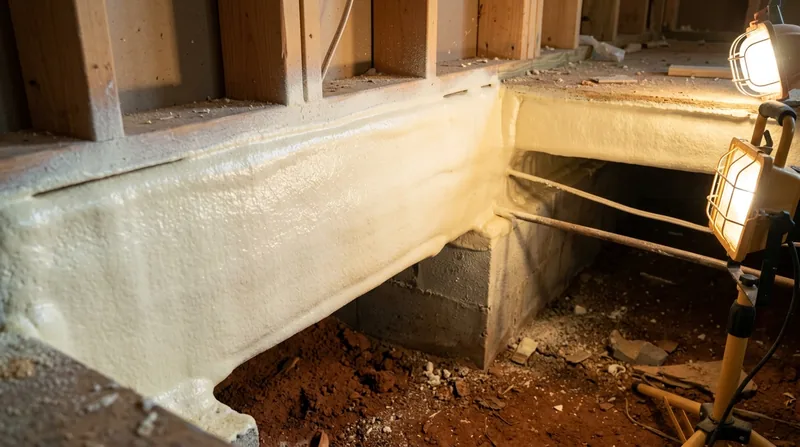




Closed cell spray foam insulation in Charlotte delivers rigid, moisture-resistant protection to the older neighborhoods that define this city's residential character. From the crawl spaces beneath Dilworth and Myers Park bungalows to the rim joists of postwar ranches across Mecklenburg County, closed cell foam adds structural integrity and controls the humidity that the Piedmont's hot summers and seasonal cold snaps drive through foundation walls and band joists. Unlike open cell foam, closed cell resists water absorption and adds measurable rigidity to walls and rim joists, making it the right choice where moisture pressure is high or where a wall needs stiffening. Charlotte's red clay terrain and the vented crawl spaces common under homes built before modern building codes mean that inward moisture migration is a chronic problem, especially in summer when warm, humid outside air meets cool foundation walls. We spray closed cell foam to stop that infiltration, seal air leaks, and strengthen the junction where frame meets foundation.
Why Closed Cell Spray Foam Matters in Charlotte's Older Neighborhoods
Charlotte's housing stock spans more than a century of building practice, and the older homes that give neighborhoods like Dilworth, Plaza Midwood, and NoDa their character were built when crawl space ventilation was standard and thermal barriers were optional. Those vented crawl spaces pull in damp outside air all summer long, and the red clay soil beneath them wicks moisture upward. Closed cell foam stops that moisture at the rim joist and band joist, where the frame meets the foundation, and it does so without absorbing water the way fiberglass batts do. In addition, closed cell foam adds rigidity to the walls of homes built over crawl spaces, bracing the rim joist against seasonal movement and the weight of the structure above. The result is a drier, more stable foundation assembly and lower cooling bills in summer because conditioned air no longer leaks down through rim joist cavities into the crawl space below.
- Closed cell foam resists moisture absorption and keeps rim joists dry in Charlotte's humid climate.
- The foam adds structural rigidity to band joists and foundation walls, bracing the frame against seasonal movement.
- Air sealing at the rim joist eliminates one of the largest unconditioned cavities in older homes, cutting cooling costs in summer.
- Closed cell foam meets code thermal barrier and ignition barrier requirements when installed to the correct thickness and with the proper covering.
These benefits make closed cell foam the standard repair for rim joists and crawl space walls across Charlotte and the surrounding Piedmont region.
Key info: Homes in Dilworth, Myers Park, and other neighborhoods built over crawl spaces lose air conditioning to uninsulated rim joists every summer. Closed cell foam seals that boundary and adds the rigidity that older foundation walls need. The Mecklenburg County building department can tell you whether your address falls under current energy code or historic preservation rules that might affect the work.
For more detail on how closed cell compares to open cell foam, see our guide to open cell spray foam insulation in Charlotte.
How We Spray Closed Cell Foam: The Process in Charlotte
Closed cell spray foam is applied in layers, typically 1 to 1.5 inches per pass, to build up the required thickness and R-value. Each pass must cure before the next is applied, and the substrate must be dry and clean before we begin. We start with a site inspection to identify air leaks, measure the cavity, check for moisture, and confirm that the area is ready for foam. If we find wet insulation, active leaks, or standing water, we stop and refer you to the appropriate specialist. Correct installation means controlled thickness, proper drum temperature, the right spray pressure, and mechanical ventilation during cure. We do not rush the job or promise immediate re-entry; a twenty-four to forty-eight hour re-entry window is standard and necessary.
- We inspect the rim joist or wall cavity, check for moisture and existing damage, and measure the space.
- We clean the substrate, seal obvious gaps with caulk or backer rod, and set up mechanical ventilation for the cure period.
- We spray closed cell foam in controlled passes, building to the specified thickness and R-value without overspraying or crushing existing framing.
- We apply a thermal barrier (drywall or intumescent paint) if the foam is exposed to living space, as required by code.
- We provide a written estimate with R-value and thickness specifications before we start, and we photograph the finished work.
This step-by-step approach is why closed cell foam jobs in Charlotte take longer than a quick spray-and-go, and why the result holds up for decades.
Example: A rim joist retrofit in Matthews or Mint Hill typically spans two to three days: inspection and prep on day one, foam application on day two, and cure verification before the homeowner re-enters the space on day three. The total board footage is small, but the care is the same as a full attic spray.
For a detailed look at how we handle insulation removal when the old material must come out first, see insulation removal in Charlotte.
Closed Cell Spray Foam Applications and Methods
| Application | Description | Why Closed Cell |
|---|---|---|
| Rim Joist and Band Joist | Sealed cavity at the foundation-to-frame junction, typically 1 to 1.5 inches of closed cell foam. | Resists moisture wicking from crawl space soil and adds rigidity to the frame above. |
| Crawl Space Walls | Foundation perimeter walls sprayed with 1.5 to 2 inches of closed cell foam to create a moisture barrier. | Stops inward moisture migration and reduces mold and mildew risk in vented crawl spaces. |
| Exterior Wall Retrofit | Injection foam into closed wall cavities of pre-1980 homes without interior demolition. | High density and rigidity fill the cavity completely and resist settling over time. |
| Metal Building and Condensation Control | Sprayed to the underside of metal roof decks or walls to prevent condensation and dripping. | Closed cell's low permeability stops warm interior air from reaching the cold metal surface. |
| Sealed Attic Roof Deck | 1.5 to 2.5 inches of closed cell foam sprayed to the underside of roof sheathing to create a conditioned attic. | Creates an air-tight thermal envelope and stops the infiltration that makes attics so hot in summer. |
Each application requires a different thickness and R-value target, which is why our estimates always specify both the depth of foam and the resulting R-value for your specific job.
Closed Cell Spray Foam Insulation Cost in Charlotte: What to Expect
Closed cell spray foam insulation costs starting at $1.20 per board foot in the Charlotte area, with most rim joist and band joist jobs ranging from $1,200 to $3,500 depending on the linear footage of the perimeter and the depth of foam required. A larger job, such as a sealed attic roof deck or a full crawl space wall retrofit, typically costs between $3,500 and $8,000 or more because it involves more board footage and longer cure time. The exact price depends on several factors: the size and shape of the cavity, whether existing insulation must be removed first, the substrate condition, site access, and the R-value target specified by code or by your builder. Homes in Belmont, Mount Holly, and Harrisburg may have different site conditions (steeper lots, more obstacles, longer drive times) that affect the final number, which is why we always provide a written estimate with R-value and thickness specs before we start.
Do not choose a spray foam contractor based on price alone. A bid with no R-value specification, no thickness detail, and no insurance verification is a red flag. We recommend getting two or three estimates and comparing not just the price but the credentials, the specificity of the scope, and the warranty offered. Our estimate is free and carries no obligation, and we can discuss what moves the price up or down for your specific situation.
For a full pricing overview and to see how different job sizes compare, visit our pricing page.
Closed Cell Spray Foam Insulation Near Me: What Charlotte Homeowners Should Know When Hiring
When you hire a spray foam contractor in Charlotte, Pineville, Matthews, or any other part of the service area, you are making a decision that affects your home's comfort and energy bills for decades. Start by asking whether the contractor is fully insured and can provide a current certificate of insurance naming your address as an additional insured. Ask for references from jobs completed in your neighborhood or in homes with a similar age and structure type. Request a written estimate that includes the R-value per inch, the total thickness, and the board footage. Verify that the contractor understands local permitting requirements, if any apply to your address. Some HOA communities have architectural review rules, and the local building department can tell you whether your property requires a permit. Never hire a contractor who promises immediate re-entry, guarantees energy bill savings, or claims to hold a license that you cannot independently verify with the state or city.
- Request a free, written estimate that specifies R-value, thickness, and board footage for your job.
- Verify that the contractor is fully insured and can provide a current certificate at your address.
- Ask for at least two references from similar jobs completed within the past two years.
- Confirm that the contractor understands what permits, if any, apply to your address by checking with your local building department.
- Review the workmanship warranty and any manufacturer system warranty that applies to the foam product.
These steps take an hour or two and can save you thousands in regret and rework down the road. If you are ready to get started, contact us for a free estimate and we will walk you through the process specific to your home and your location.
Closed Cell Spray Foam Insulation in Charlotte: Pricing Guide
| Service | Price | Details |
|---|---|---|
| Rim Joist and Band Joist Retrofit | Starting at $1.20/board ft | Typical 1 to 1.5 inch closed cell foam application; final cost depends on linear footage of perimeter and substrate condition |
| Crawl Space Wall Insulation | Starting at $1.20/board ft | Full perimeter application; cost increases with wall height, moisture remediation needs, and removal of old fiberglass or settling insulation |
| Sealed Attic Roof Deck | Starting at $1.50/board ft | 1.5 to 2.5 inch closed cell application for unvented attic; larger square footage and removal of old insulation can increase cost significantly |
| Exterior Wall Injection Retrofit | Starting at $1.50/board ft | Closed cavity retrofit without demolition; final cost depends on cavity depth, number of walls, and complexity of drilling and patching |
| Metal Building or Condensation Control | On estimate | Spray application to underside of metal roof or walls requires site inspection for structure type, span, and ventilation requirements |
| Free Estimate and Site Visit | No charge | Response within 24 hours, detailed written scope with R-value and thickness specs, no obligation to book; call (980) 217-3281 |
Indicative pricing, the exact cost depends on square footage, finish, and site access. Free personalized estimate within 24h at (980) 217-3281.


