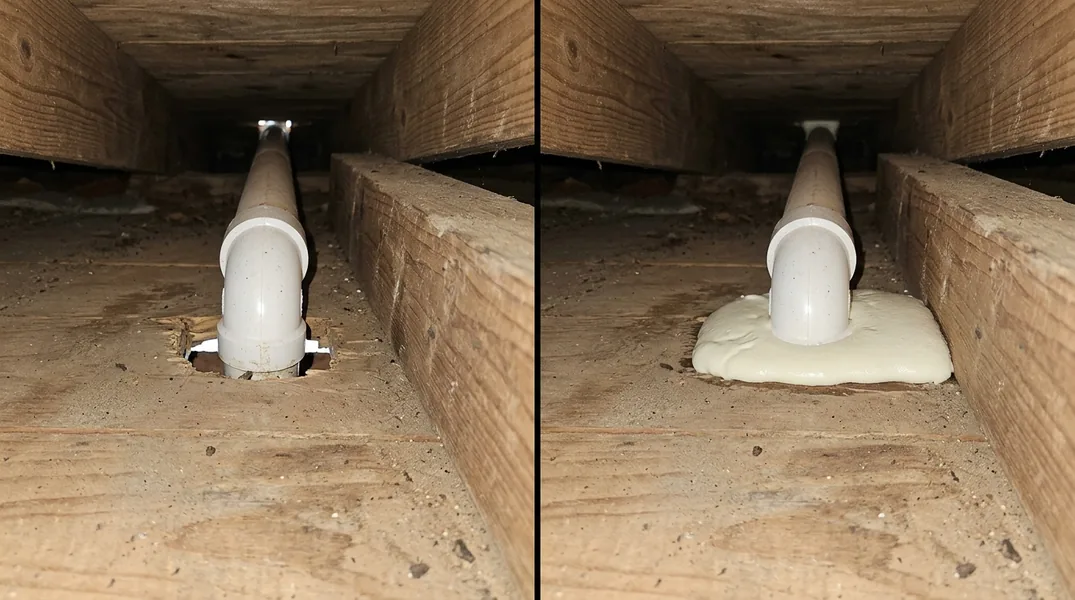
Understanding the Difference Between Air Sealing and Spray Foam
When it comes to improving your home's energy efficiency, two approaches dominate the conversation: air sealing and spray foam insulation. While these methods are sometimes presented as competitors, they actually serve different purposes, and understanding that distinction is crucial for Charlotte homeowners looking to make an informed decision.
Air sealing focuses on identifying and closing gaps, cracks, and penetrations where conditioned air escapes your home. This might include sealing around window frames, door jambs, electrical outlets, and ductwork. It's typically done with caulk, weatherstripping, or foam sealant and addresses the problem of air leakage directly. Attic Spray Foam Insulation, by contrast, serves a dual purpose: it provides thermal resistance (measured in R-value) while simultaneously sealing air gaps as it expands and cures. This makes spray foam a more comprehensive solution that tackles both insulation and air sealing in a single application.
Spray Foam Insulation R Value Per Inch: What You Need to Know
The R-value is a measure of thermal resistance, and it's one of the most important metrics when evaluating any insulation product. Understanding how much insulation value you're getting per inch of material helps you compare options fairly and ensure you're meeting local energy codes. Closed Cell Spray Foam Insulation typically delivers between 6.5 and 7.5 R-value per inch, making it one of the most efficient insulation materials available. Open Cell Spray Foam Insulation, meanwhile, provides approximately 3.5 to 3.8 R-value per inch.
The higher R-value per inch of closed cell foam means you need less material to achieve the same thermal resistance compared to fiberglass batts (typically 3.2 to 3.8 per inch) or blown cellulose (around 3.2 to 3.6 per inch). For Matthews and Mint Hill homeowners with space constraints in their attics, this efficiency can be a game-changer. However, the choice between closed cell and open cell depends on your specific goals, budget, and application. Closed cell is more expensive but offers superior moisture resistance and air sealing. Open cell is more affordable and still provides excellent thermal performance for many applications.
R Value Requirements by State: Where Does North Carolina Stand?
North Carolina's energy code requirements for attic insulation are based on the International Energy Conservation Code (IECC), and they vary depending on your specific location within the state. For most of the Charlotte region, which falls into climate zone 4A, the current code typically requires an R-value of R-38 to R-49 for attic insulation, depending on whether you're building new construction or performing a retrofit. This translates to roughly 10 to 13 inches of closed cell spray foam or 12 to 16 inches of open cell foam.
It's important to note that code requirements represent the minimum standard for energy efficiency. Many homeowners choose to exceed these minimums, especially when investing in spray foam, because the cost difference between meeting code and exceeding it is often minimal. Exceeding the minimum R-value can result in greater energy savings, more consistent indoor temperatures, and better long-term comfort. When you're considering a spray foam project, discussing your local R-value requirements with a professional is essential, as they can help you understand both the code minimums and the practical benefits of going beyond them. This is another reason to contact Charlotte Spray Foam Insulation for a free estimate that takes your specific needs into account.
How Thick Should Spray Foam Be? Finding the Right Depth for Your Home
Determining the appropriate thickness for spray foam insulation depends on several factors: your target R-value, the type of foam you choose, your budget, and your home's specific condition. There's no one-size-fits-all answer, but understanding the relationship between thickness and performance helps you make a decision that aligns with your goals and financial constraints.
If you're aiming for the North Carolina energy code minimum of R-38 in your attic, you'd need approximately 5.5 to 6 inches of closed cell spray foam (at 6.5 to 7 R-value per inch). However, many homeowners opt for 6 to 8 inches to achieve R-45 to R-56, which provides a comfortable buffer above code and maximizes energy savings. The thickness also depends on whether you're insulating an attic floor, cathedral ceiling, or exterior walls, as each application has different considerations. For Pineville homeowners dealing with older homes, spray foam can be applied in layers, allowing you to build up to your desired thickness over time if budget is a concern, though a single application is typically more cost-effective.
Insulation Tax Credit and Rebates: How to Save Money on Your Project
One of the most attractive aspects of upgrading your home's insulation is the potential for financial incentives. The federal government, as well as many state and local utilities, offer programs designed to encourage homeowners to improve their energy efficiency. An insulation tax credit can significantly reduce the out-of-pocket cost of your spray foam project, making it more affordable than you might initially think.
Federal tax credits for energy-efficient home improvements have been available in recent years and may allow you to claim a percentage of your insulation project costs directly on your tax return. Additionally, many North Carolina utilities offer rebates for insulation upgrades, particularly when combined with air sealing or other efficiency measures. Duke Energy, for example, frequently runs programs that provide rebates for qualifying insulation improvements. These incentives vary by location and change periodically, so it's worth checking with your local utility and consulting with a tax professional about what you might qualify for. When you request a free estimate from Charlotte Spray Foam Insulation, our team can often provide guidance on current incentive programs and help you understand the true cost of your project after accounting for available rebates and credits.
Air Sealing vs. Spray Foam: Which Is Right for Your Charlotte Home?
The honest answer is that for most homeowners, the question isn't really either/or. Rather, it's about understanding when each approach makes sense and how they can work together. If you have an older home with significant air leakage in accessible areas like rim joists, band boards, or around penetrations, basic air sealing can deliver impressive energy savings at a relatively low cost. However, if you're looking for a comprehensive solution that addresses both insulation and air sealing simultaneously, spray foam is the more effective long-term investment.
Spray foam excels in attics, crawl spaces, and areas where you need both thermal resistance and air barrier properties. It conforms to irregular spaces, fills gaps that would be difficult to seal manually, and creates a continuous air barrier that air sealing alone cannot achieve. The pricing for spray foam is higher upfront, but when you factor in the superior performance, durability, and the potential for insulation tax credits and rebates, the return on investment becomes compelling. For Charlotte homeowners serious about reducing energy bills, improving comfort, and protecting their home from moisture and pests, spray foam is typically the better choice. If you're still weighing your options, call Charlotte Spray Foam Insulation at (980) 217-3281 to discuss your specific situation and get professional guidance tailored to your home.
Looking for a professional spray foam insulation contractor in Charlotte? Charlotte Spray Foam Insulation responds fast for all your spray foam insulation needs.
Get a Free Quote